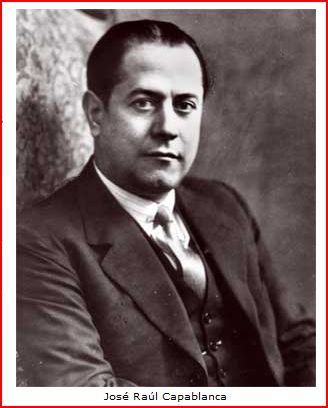
 Rounds 3 and 4 saw an impressive turnout of 19 players, almost a record for a club night. Encouraging to see a lot of new Junior members coming along. First up was Lasker vs Capablanca, 1921 Havana. (game 10 of the actual tournament).
In 1911, José Raúl Capablanca first challenged Emanuel Lasker for the world championship. Lasker had this to say in his newspaper column: Capablanca’s compatriots have a desire to see him contest the world’s championship. Today (February 28th) I received a letter from Senor Paredes of the Habana Chess Club, asking me to play with Capablanca in the Cuban city a match of ten games up, draws not to count. This proposition is not acceptable. In the present period of draw-making, such a match might last half a year and longer. I am, of course, deliberating upon my reply, but I do not think that I shall care to play in a semi-tropical climate more than a few games. Several months later, Dr. Lasker countered with a list of his own terms, but Capablanca disputed many of them, most notably a 2-wins victory requirement. And so, the negotations broke down over differences of the match conditions. In the decade that followed, Capablanca took the chess world by storm, getting the best of nearly every top player of that period. By 1920, Lasker recognized Capablanca’s prowess, and resigned the title to him, saying, “You have earned the title not by the formality of a challenge, but by your brilliant mastery.” Capablanca, having felt robbed of his chance to win the title in the traditional fashion, convinced Lasker to play, but Lasker did so only on condition that his resignation be accepted, and he be regarded as the challenger. Lasker’s resignation was not widely recognized at the time, nor today, therefore this match is generally regarded as the one in which the title changed hands. In Havana, from March 15 to April 28, 1921, the match took place. Whomever you regard as the challenger, the winner was Capablanca, who prevailed without a single loss, +4 -0 =10. Four games down, with at most 10 more to play, Lasker resigned the match prematurely after Game 14, citing ill health, and Capablanca became the third World Chess Champion. The games score, with notes by Capablanca, can be found here (more…)
 The second game of the night was the seventh game from Lasker vs Steinitz 1894 New York / Philadelphia / Montreal
 Game 1 was drawn from Zukertort vs Steinitz 1886 New York / St. Louis / New Orleans. The Polish-Jewish master Johannes Zukertort gained worldwide recognition when he won the international tournament in Paris, 1878. In 1883, he won the international tournament in London, defeating nearly every leading player in the world. Steinitz, who placed second, trailed Zukertort by three full points. After such a commanding performance, Zukertort was considered by many to be the unofficial World Champion. In 1886 these two great chess minds sat down to play what is now regarded by most chess historians as the first official World Chess Championship. The conditions were that the first player to achieve 10 wins (draws not counting) would be crowned champion. (This method, “first to 10 wins”, was to become the center of a controversy almost a hundred years later, when Fischer and FIDE came to an impasse over the World Championship format.). Steinitz suffered a series of defeats at the beginning of the match, but soon overcame his deficit. In the 20th game, Steinitz played a combination right out of the opening which netted Zukertort’s queen, forcing him to resign, ending the match with a score of 10 to 5.
 A good turnout last night despite the stormy weather, with fourteen competing in the second half of the Fischer Random Tournament. In the end Michael once again on top with 6 points. Gary and Hilton tied for second equal on 4 points. The starting positions for games 4 5 and 6 are at right, and the final crosstable is below. We will have casual chess next week, or perhaps a mini tournament, depending on the mood of the troops.
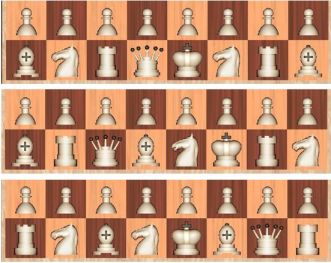 Opening preparation went out the window with a little light hearted fun last night in the form of Fischer Random minitournament. The games were played at 15 + 0. An excellent turnout with 17 players present. After the first three rounds of Michael is in the lead, with Ian and Richard tied on second equal. The starting positions for games 1, 2, 3 are shown in the graphic at left, and the cross table so far is below. Three more rounds of diabolical starting positions next week. Fischer random games are not eligible for club ratings
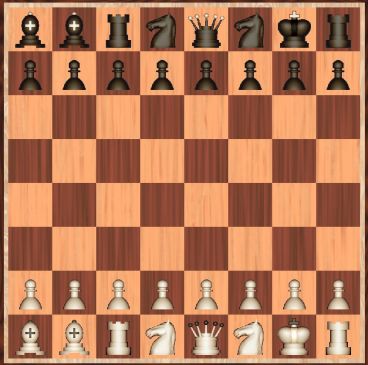 Something different for the next two weeks! We will play a six round swiss tournament over 2 nights using Chess960 (or Fischer Random Chess). Chess 960 is a chess variant invented and advocated by former World Chess Champion Bobby Fischer, publicly announced on June 19, 1996 in Buenos Aires, Argentina. It employs the same board and pieces as standard chess; however, the starting position of the pieces on the players’ home ranks is randomized. The random setup renders the prospect of obtaining an advantage through the memorization of opening lines impracticable, compelling players to rely on their talent and creativity. The time control will be 15 + 0, 3 games per night over the six nights. Games wont be used for club rating purposes. These are some quotes about Chess960:
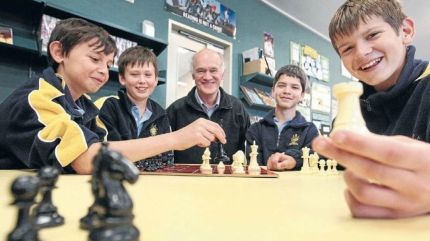 The Fairfield School team features in this week’s edition of the Hamilton Press following their recent win in the Intermediate division of the Waikato School Pupil’s regional final. Club junior members Samuel Eddy and Brandon Cuellar, along with their coach, club member William Lynn, are shown alongside the other two members of the team Maxim Stephens and Jayden Randall. The full article can be accessed
  Hamilton Chess Club