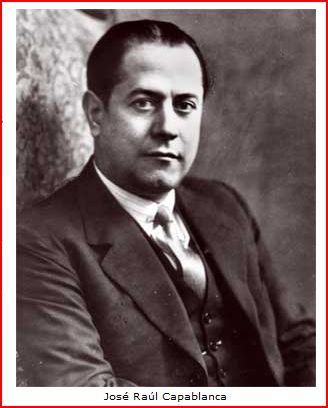
 Rounds 3 and 4 saw an impressive turnout of 19 players, almost a record for a club night. Encouraging to see a lot of new Junior members coming along. First up was Lasker vs Capablanca, 1921 Havana. (game 10 of the actual tournament).
In 1911, José Raúl Capablanca first challenged Emanuel Lasker for the world championship. Lasker had this to say in his newspaper column: Capablanca’s compatriots have a desire to see him contest the world’s championship. Today (February 28th) I received a letter from Senor Paredes of the Habana Chess Club, asking me to play with Capablanca in the Cuban city a match of ten games up, draws not to count. This proposition is not acceptable. In the present period of draw-making, such a match might last half a year and longer. I am, of course, deliberating upon my reply, but I do not think that I shall care to play in a semi-tropical climate more than a few games. Several months later, Dr. Lasker countered with a list of his own terms, but Capablanca disputed many of them, most notably a 2-wins victory requirement. And so, the negotations broke down over differences of the match conditions. In the decade that followed, Capablanca took the chess world by storm, getting the best of nearly every top player of that period. By 1920, Lasker recognized Capablanca’s prowess, and resigned the title to him, saying, “You have earned the title not by the formality of a challenge, but by your brilliant mastery.” Capablanca, having felt robbed of his chance to win the title in the traditional fashion, convinced Lasker to play, but Lasker did so only on condition that his resignation be accepted, and he be regarded as the challenger. Lasker’s resignation was not widely recognized at the time, nor today, therefore this match is generally regarded as the one in which the title changed hands. In Havana, from March 15 to April 28, 1921, the match took place. Whomever you regard as the challenger, the winner was Capablanca, who prevailed without a single loss, +4 -0 =10. Four games down, with at most 10 more to play, Lasker resigned the match prematurely after Game 14, citing ill health, and Capablanca became the third World Chess Champion. The games score, with notes by Capablanca, can be found here Read the rest of this entry »
 We will have 8 rounds of blitz next week — the first 4 at time control of 3 minutes plus 2 seconds a move, and then 4 games at 5 minutes plus 3 seconds a move. Visitors and guests are welcome to join in. Games start 7:20 sharp so dont be late.
 Rounds 9 and 10 were from Kasparov vs Kramnik, 2000. London and from Anand vs Kramnik, 2008. Bonn, Germany
 In an effort to boost membership, and in recognition that this month the World Chess Championship will take place, Hamilton Chess Club is pleased to offer a significant discount off our usual membership subscription rate. The offer applies to both adult and junior memberships. To take up the offer you must never have previously been a financial member of the club, and must pay your membership fee before 1 December 2013. For the usual annual fee ($40 adult, $20 junior) you will be credited with 15 months membership, representing a 25% bonus over the usual rate.
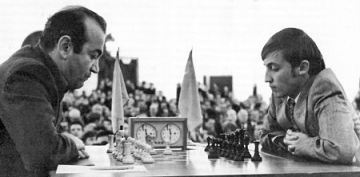 Game 8 was drawn from the 1978 World Chess Championship was played between challenger Viktor Korchnoi and champion Anatoly Karpov in Baguio City, Phillipines. The conditions of the match were changed for the first time since 1951: the 24 game format was replaced with an unlimited game format, with the first player to win 6 games being declared champion. The rematch clause for the Champion, which had been discarded since 1963, was brought back into effect. This was not the first match betwen Korchnoi and Karpov. In the 1974 candidates matches, after defeating Lev Polugaevsky and Boris Spassky in preliminary matches, Karpov beat Korchnoi in the 1974 candidates final by the close score of +3 -2 =19. Korchnoi had been one of the USSR’s top grandmasters for over 20 years. He had won the Soviet Championship on four occasions and had had reached the Candidates final twice. When Korchnoi dramatically defected from the USSR in 1976, he set the stage for one of the most bitterly contested matches in WCC history, filled with high political drama, tension, and accusations. The political ramifications of a Soviet defector winning the chess crown hung heavy on the match atmosphere. Numerous accusations were traded by the two camps. Korchnoi continously complained that he was being stared at by a member of Karpov’s team during play, a parapsychologist supposedly with hypnotic powers. Karpov objected to Korchnoi’s wearing of sunglasses which he said deflected light on his eyes. At one point in the match the players stopped shaking hands and all further communication stopped. Draws offers were conveyed through the arbiter.
 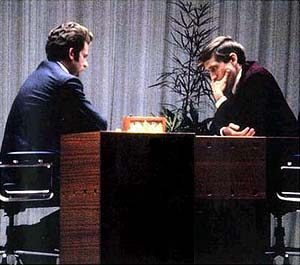 “The Match of the Century”
 MindSport Festivals and Competitions are held in Europe – and next February – Thames on the Coromandel Peninsula is championing the first of its kind in New Zealand. Along with serious competitors, the event will provide a fun environment for anyone who plays a sport of the mind to compete equally and fairly in the spirit of good will and sportsmanship. There will be a Street Party with local Bands on Friday evening 28th February 2014 – and a multi bar Quiz Night on Saturday 1st March 2014. Chess will be one of the competitive events. For further details the website is
 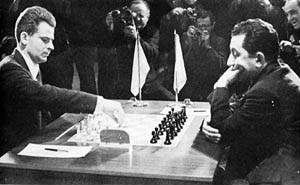 Game 6
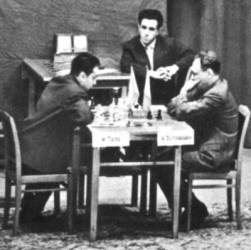 Game 5 was drawn from Tal vs Botvinnik 1960 Moscow
 The second game of the night was from a clash of the titans: Capablanca vs Alekhine 1927, Buenos Aires
 Hamilton Chess Club